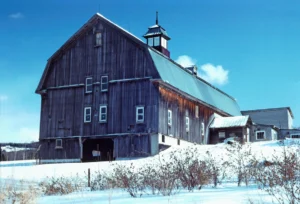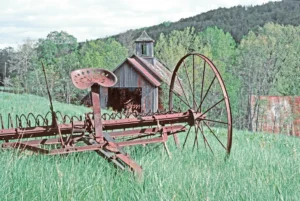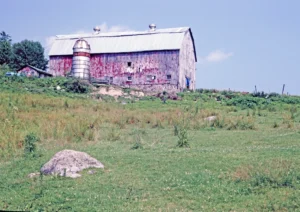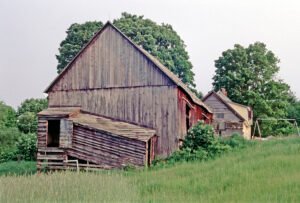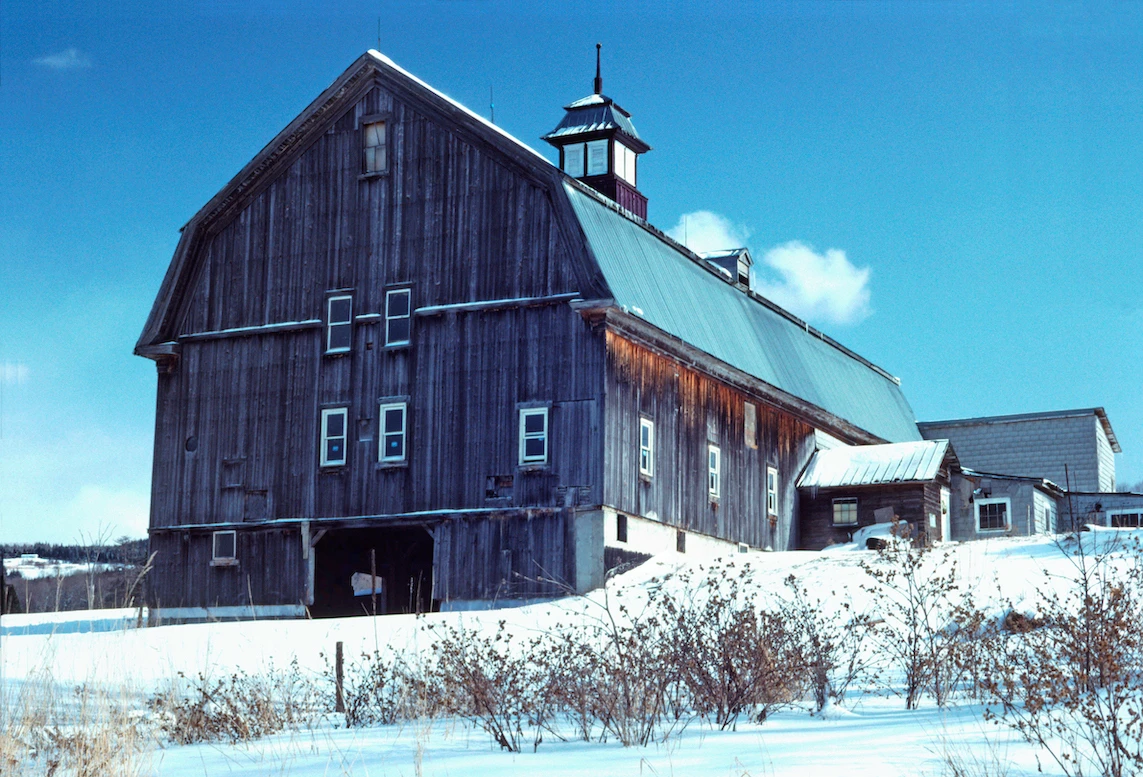
Years ago, I met Dick Babcock, a man who knew more about old barns than anyone I ever met. Dick was an antique barn restorer who could hand-hew a replacement beam or cut a perfect mortise-and-tenon joint using nothing but traditional hand tools.
Dick was self-conscious about never having finished high school. Yet he was the one who introduced me to the golden rectangle, a geometric principle that has influenced artists and architects for centuries.
The golden rectangle has a length-to-width ratio of approximately 1.618 to 1, known as the golden ratio. This proportion has long been associated with beauty, balance, and harmony in design.
Dick believed that one reason old barns are so pleasing to the eye is that many oldtime barn builders instinctively used these proportions in their designs. Whether or not they consciously applied the golden ratio, they often created buildings whose proportions seem remarkably balanced.
The golden ratio has appeared in discussions of art, architecture, and design for centuries. Artists and architects have explored its potential to create harmonious compositions, establish visual balance, and guide the viewer’s eye through a work.
Famous buildings, including the Parthenon and Le Corbusier’s Villa Stein, are often discussed in connection with these proportions, although claims about their precise use of the golden ratio are sometimes disputed.
A golden rectangle can be constructed using a simple geometric method:
- Draw a square.
- Find the midpoint of one side.
- Draw a line from that midpoint to the opposite corner of the square.
- Using that line as a radius, extend the square by drawing an arc to establish the rectangle’s longer dimension.
- Complete the rectangle using the resulting proportions.
The golden rectangle is more than a mathematical curiosity. It offers a useful way to think about proportion and visual balance, whether in architecture, painting, or photography.
I use the golden rectangle when composing my photographs, particularly when cropping an image. It helps me move beyond the habit of placing the subject directly in the center of the frame. By positioning the subject off-center and allowing the surrounding space to contribute to the composition, I can often create a more engaging photograph.
After all, a good photograph, like a well-proportioned barn, is not simply a matter of what you see. It is also a matter of how the elements fit together.